
In the early days of building a company, funding often feels like a destination. It looks like validation. It looks like momentum. It looks like progress.
But the truth is quieter and far more practical. Funding is not a badge of success. It is a tool. And like any tool, it is only useful when used at the right stage, for the right purpose.
Many founders assume that raising capital is a natural step in the journey of growth. But, in reality, most businesses are not built on external funding at all. India today has one of the largest startup ecosystems in the world, yet only a small fraction of startups actually raise institutional capital. Most businesses, even today in India, are built through revenue, iteration, and disciplined scaling.
This immediately reframes the real question from “When should we raise?” to “Do we actually need funding right now?”
Somewhere along the evolution of startup culture, fundraising became a symbolic milestone. Announcements, valuation headlines, and investor logos began to signal credibility. Over time, the narrative subtly shifted from building a strong business to building a fundable one.
But capital is never neutral. It comes with expectations of speed, scale, and outcomes. The moment external money enters, expectations around performance change. Growth is no longer just about what is sustainable. It becomes about what is scalable within a defined time.
Recent ecosystem trends clearly reflect this shift in thinking. Investors in India are increasingly prioritising profitability, capital efficiency, and sustainable growth rather than unchecked expansion.
Ecosystem data reflects this shift in thinking. Investors in India are increasingly prioritising profitability, capital efficiency, and sustainable growth instead of rising at any cost. The India Venture Capital Report by Bain and Company highlights how investor focus has moved toward disciplined, fundamentals-driven investing rather than unchecked expansion narratives.
This means raising money too early can create pressure to scale before the business is structurally ready. And scaling a fragile model rarely fixes it. It only magnifies what is already weak.
The Real Starting Point: Understanding Your Growth Engine
Before even thinking about funding, a founder needs to step back and look at how the business is actually growing, not just in projections.
Is growth coming from repeat customers?
Does efficient distribution drive it?
Is demand already exceeding supply?
Or is growth still inconsistent and experimental?
In most consumer and consumer-tech businesses, the growth engine rests on four simple pillars: product strength, distribution efficiency, operational capacity, and team execution. If these are working in sync, capital can accelerate growth meaningfully. If they are still evolving or unstable, funding often becomes an expensive way to buy time rather than build momentum.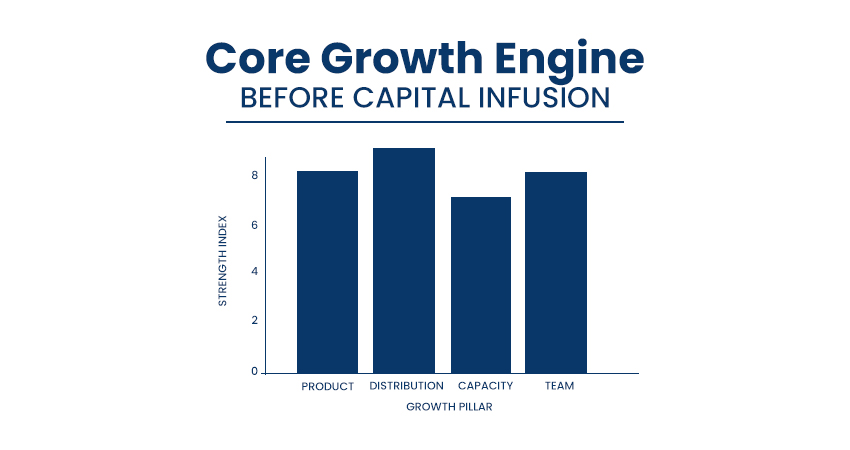 A simple way to think about it is this – Capital should fuel an engine that is already running, not one that is still being assembled.
When You Probably Do Not Need Funding Yet
There are several stages where funding sounds attractive but is actually premature.
The first is when the business is still figuring out product-market fit. At this stage, learning speed matters more than scaling speed. Injecting capital here often pushes founders to chase growth metrics instead of refining the core offering.
Another stage is when unit economics are still unstable. If every new customer acquired increases losses instead of improving contribution margins, funding does not solve the problem. It only funds the losses on a larger scale. This is especially relevant in digital-first categories where customer acquisition costs have been steadily rising due to platform competition and higher ad bidding intensity.
There is also the case of businesses that are already growing steadily through internal cashflows. If revenue can support operations, reinvestment, and gradual expansion, external capital may introduce unnecessary dilution and pressure without a proportional strategic benefit.
Often, patience builds stronger businesses than premature capital.
The Unit Economics Reality Check
One of the most honest questions a founder can ask is whether the business becomes healthier or more fragile as it grows.
If margins improve with scale, capital can amplify a good model. If margins shrink with scale, capital only delays the inevitable correction.
This is especially relevant in India’s highly competitive consumer landscape, where rising customer acquisition costs and discount-driven growth have made sustainable unit economics more critical than ever. Reports indicate that paid acquisition is becoming more expensive as more brands compete for the same digital attention.
This means businesses that rely heavily on discounting or aggressive paid marketing without strong retention are not truly scaling. They are spending to sustain visibility. Funding such a model does not create efficiency. It deepens dependency on capital.
When Funding Actually Makes Sense
Funding becomes powerful only when the business is already working but constrained by resources, not by clarity.
For example, if demand is strong but inventory or manufacturing capacity is limited, capital directly unlocks growth. If customer acquisition is efficient but budgets are capped, funding can unlock faster distribution. If the product has strong retention but innovation is slow due to resource constraints, capital can deepen the offering.
In such cases, funding is not being used to “find growth.” It is being used to accelerate proven demand.
This becomes even more relevant in fast-growing consumer and digital commerce markets. India’s D2C and e-commerce markets are expanding rapidly and are projected to reach $180–200 billion by 2030, driven by digital adoption and evolving consumer behaviour.
In these environments, speed can become a competitive advantage. Waiting too long to scale distribution or brand presence may mean losing market share to faster-moving competitors.
The Speed vs Discipline Dilemma
Bootstrapped growth builds discipline as every decision is tied to cashflows. Teams become efficient. Experiments become sharper. Spending becomes intentional.
Funded growth, on the other hand, builds velocity. It allows faster hiring, faster market expansion, deeper inventory cycles, and stronger brand visibility.
Neither path is inherently superior. The right choice depends on category dynamics, competitive intensity, and operational readiness.
If a category is crowded and rapidly scaling like beauty, wellness, or consumer tech, slow growth can quietly reduce long-term relevance. But if a category rewards depth, brand trust, and operational consistency, measured growth can create stronger long-term defensibility.
Therefore, the real strategic question is not whether funding is good or bad. It is whether speed is a competitive necessity for your category. If the opportunity lost by slow scaling is larger than the equity given up, funding becomes a rational decision.
Timing: The Often Ignored Variable
The ideal time to raise funding is rarely at the idea stage. It is usually when the business transitions from experimentation to repeatability.
This is when patterns start becoming visible. Customer behaviour stabilises. Acquisition channels become predictable. Retention data becomes meaningful. Operations shift from reactive to structured.
At this stage, capital does not change the direction of the business. It accelerates a direction that is already validated.
Another important aspect is organisational readiness. Scaling requires systems, senior talent, and operational infrastructure. Many founders reach a stage where growth is limited not by demand but by bandwidth and execution capacity. Funding, in such cases, enables the transition from a founder-led model to a system-led organisation, or we can say it acts as a structural enabler rather than a survival mechanism.
The Hidden Cost of Capital Founders Overlook
Funding is often viewed purely as financial fuel, but it also reshapes how a company operates. Decision cycles become faster. Growth expectations become sharper. Strategic flexibility reduces as accountability increases.
What founders often overlook is dilution of control, pressure for faster exits, reduced freedom in long-term experimentation, and alignment risks if investor vision differs.
This is not negative. It is simply a structural shift.
Recent data shows that investors are becoming more selective and writing fewer but more focused checks, favouring companies with clear fundamentals and disciplined growth paths. For instance, India’s startup ecosystem raised $10.5 billion in 2025, but funding rounds fell by nearly 39% to 1,518 deals. Seed-stage funding dropped to $1.1 billion, down 30% year-on-year, while late-stage funding declined to $5.5 billion, down 26%, reflecting sharper scrutiny on scale, profitability, and exits. In contrast, early-stage funding rose to $3.9 billion, up 7% year-on-year, showing a clear shift toward startups with stronger product-market fit, revenue visibility, and unit economics.
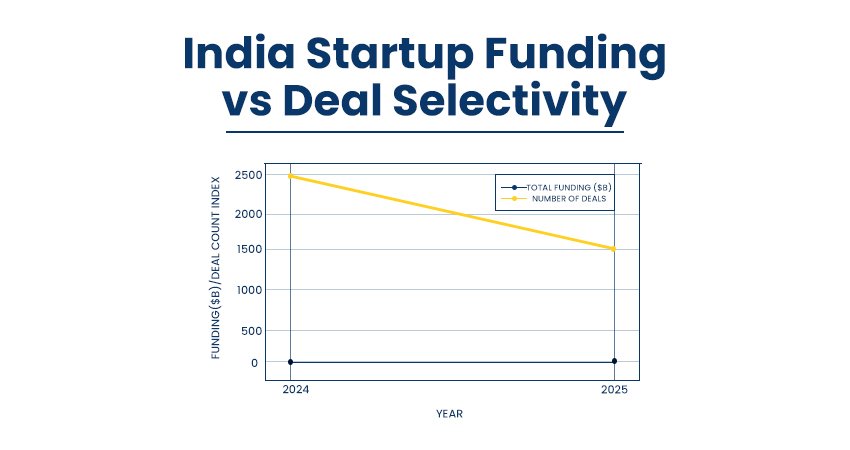
This makes timing and readiness even more critical than access to capital.
A More Grounded Way to Think About Funding
Instead of asking whether funding is available, it is more useful to ask a simpler and honest question: Will capital accelerate the business faster than internal cash flows can, without breaking unit economics?
If the growth engine is proven and capital removes a real bottleneck in distribution, capacity, product, or team, funding becomes a multiplier. If the engine is still unclear and capital is used to experiment or subsidise losses, funding quietly becomes a distraction.
In the long run, the strongest businesses are not defined by how much capital they raise, but by how clearly they understand their consumers, how disciplined they remain with unit economics, and how thoughtfully they choose their pace of scale.
In the end, funding should not be treated as validation or a milestone to chase. It should be treated as acceleration. And the most powerful position for any founder is not needing capital to survive, but choosing to raise only when it can responsibly and meaningfully scale what is already working.