When brands expand their distribution, problems often go unnoticed at first. The brand appears in more places, but not always consistently. Buyers see several options and may not know which one is the right choice. Even if the product quality stays high, the brand becomes harder to pick quickly. In beauty and personal care, where trust and repeat purchases matter most, anything that causes buyers to hesitate can hurt the business.
This hesitation isn’t just about branding or marketing. It’s really a distribution design issue: the brand’s identity needs to stay clear as it appears in more places.
The number of ways to buy is growing fast. In India, beauty and personal care is being shaped by three main trends:
- Digital acceleration: NielsenIQ-reported coverage shows beauty e-commerce + quick commerce sales value up 39% YoY (June–Nov 2024), compared with ~3% growth in physical stores over the same period.
- Speed becoming normal: In 2024, more than two-thirds of e-grocery orders and one-tenth of e-retail spend happened on quick commerce, and q-commerce is forecast to grow 40%+ annually until 2030.
- The next 100 million shoppers aren’t only metros: Tier II/III towns account for 60%+ of e-commerce transactions.
Multi-channel is no longer just a strategy. It’s not how the market works.
The real challenge is figuring out how a BPC brand can grow across more channels without making buyers rethink their choices.
The confusion tax in BPC doesn’t look dramatic — it looks like friction
Confusion in BPC rarely leads to complaints. Instead, it causes buyers to hesitate.
A buyer who once reordered quickly now spends time scrolling. Someone who trusted the product now checks the listing, the seller, the size, and the variant name. A buyer who knew what to buy first may now see three different ‘bestsellers,’ depending on the app they use.
This hesitation is costly because BPC products are bought regularly. When buying becomes harder, people stop repeating their purchases.
Founders often think the problem is having too many channels. But the real issue is more specific:
Brands don’t confuse buyers by adding more channels. They confuse them by being inconsistent across those channels.
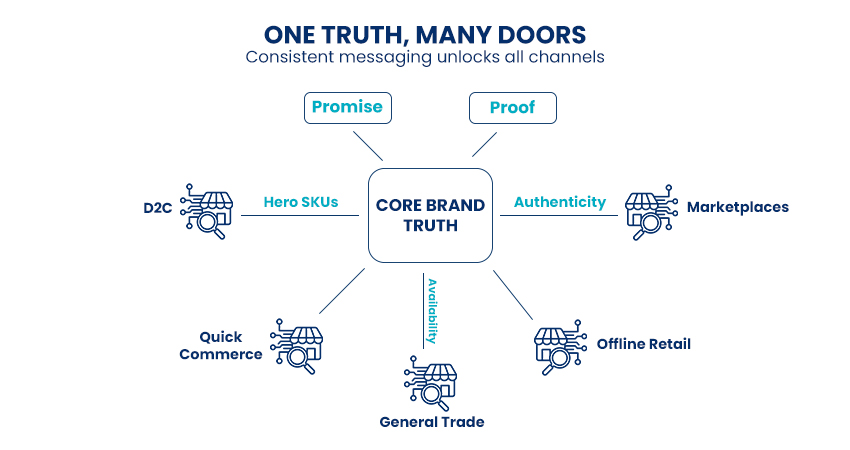
The principle that keeps multi-channel growth clean: one truth, many doors
The best multi-channel BPC brands see each new channel as a different entrance to the same brand, not as a separate experience.
This consistent brand experience is built on things the buyer should never have to relearn:
- the hero product hierarchy (what to start with, what to repeat)
- the promise (what it solves, in plain language)
- the proof (why it works, consistently stated)
- the authenticity cues (so “is it genuine?” never becomes a question)
- the availability expectation (where it will reliably exist when needed)
When these basics stay the same, channels can vary in product range, packaging, and convenience without confusing buyers.
Why channel roles matter more in BPC than in most categories
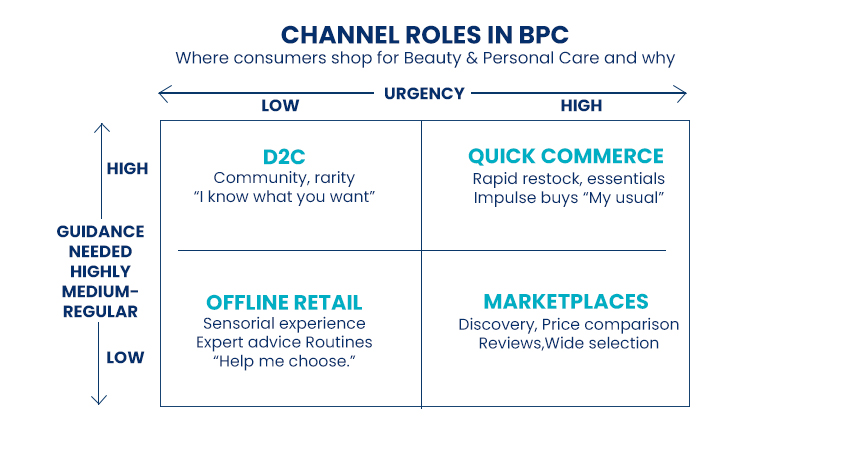
In BPC, the way people buy changes depending on the channel:
- Quick commerce is often replenishment, urgency, and “top-up.”
- Marketplaces are comparison, validation, and scale discovery.
- Offline is sensory confidence, reassurance, and the sense that “this feels real.”
- D2C is depth, routines, education, and higher AOV economics.
Global category research supports this view: McKinsey expects online to account for nearly one-third of global beauty sales by 2030 (up from 26% in 2024), while offline remains dynamic and important.
In India, the strongest proof comes from what leading brands are actually doing:
- Nykaa has built a true omnichannel engine: its offline network spans 237 stores across 79 cities, and it added 50 stores in FY25—its largest annual offline expansion.
- In the same year, Nykaa’s Superstore distribution arm (B2B) scaled to 276,000+ transacting retailers across nearly 1,100 cities and towns, with FY25 GMV reaching ₹941 crore (+57% YoY).
- Nykaa is also building speed as a first-class door: executives have discussed Nykaa Now, with a 60-minute delivery aim (within a 2-hour promise), and expansion into more metros.
This is what’s happening in BPC: there are more ways for buyers to access brands, not fewer. The only way to keep up is to design the buyer’s experience for every channel.
Where buyer confusion actually comes from: identity splits
Most BPC brands don’t lose customers because of poor products. They lose them when the brand’s identity becomes unclear.
These identity splits usually appear in five subtle ways:
1) The hero gets lost.
Buyers can’t easily find the main product to start with because each channel organises products differently. Quick commerce highlights fast sellers, marketplaces show the biggest discounts, offline stores focus on value packs, and D2C highlights routines. Each approach makes sense on its own, but together they make it harder for buyers to make their first choice.
2) Names and variants start drifting.
The same product might be called ‘Hydrating Cleanser’ in one place, ‘Barrier Cleanser’ in another, and ‘Daily Cleanser’ somewhere else, because different teams create listings at different times.
3) Proof changes by channel.
The product’s benefits are described differently in each channel, from ingredients to claims to usage instructions, which can make it seem like several different products.
4) Authenticity becomes a question.
If a buyer starts to wonder, ‘Is this genuine?’, the doubt doesn’t just stay with that platform; it affects trust in the whole brand. Counterfeit cosmetics are a real issue in India, and public DRI reports include them among seized goods.
5) Availability is unreliable where the buyer formed a habit.
In fast-paced retail, when a key product is out of stock, it doesn’t just seem like a supply issue; it makes the brand seem unreliable.
According to a report by Business of Fashion, q-commerce is being highlighted as a significant emerging opportunity for beauty in India because it enables easier product discovery and faster replenishment for consumers, though it also introduces new execution challenges.
The “no-confusion” operating system for multi-channel BPC growth
The way to scale distribution without buyer confusion is not to “be everywhere.” It’s to create a single operating truth and let channels express it differently.
This operating system has three parts:
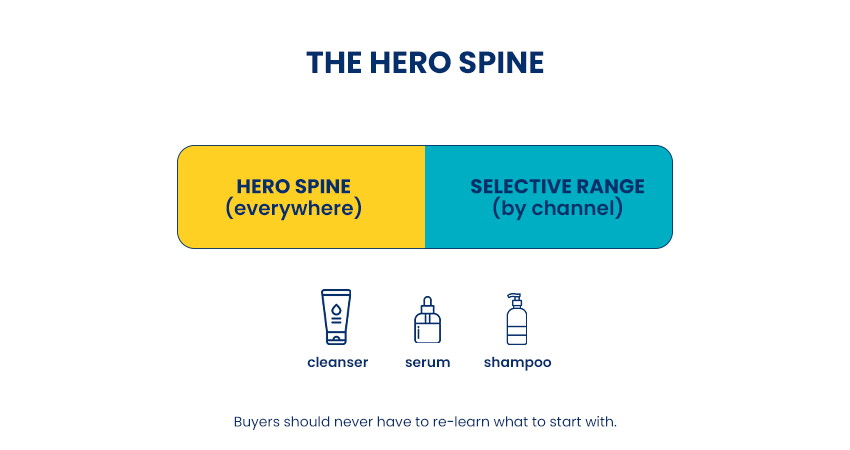
1) Build a “hero spine” that exists everywhere
The hero spine is a small set of SKUs that are always easy to find across doors, always recognisable in packaging, and always described with the same promise/proof language.
It’s the buyer’s anchor.
The spine is not “everything that sells.” It’s what the brand stands for. In active-led skincare, it may be a cleanser + serum + moisturiser trilogy. In hair care, it may be a shampoo, conditioner, and serum ladder. In colour cosmetics, it may be a base product, a hero lip, and a hero eyeliner.
Without this spine, channels start inventing their own “front door,” and the buyer has to do interpretation work.
Real brand pattern (why this works):
Nykaa’s Superstore scale is instructive here: when distribution reaches 276k+ retailers across ~1,100 towns, what holds together isn’t “more SKUs.” It’s recognisable winners with consistent demand signals. A hero spine gives the same clarity advantage even before that scale arrives.
2) Give each channel a role, then match the shelf depth to the role
This is where “real operator” thinking shows up.
A brand doesn’t need the same assortment everywhere. It needs the same hierarchy everywhere.
- Quick commerce shelf should be narrow and dependable—hero spine + 1–2 high-frequency adjacencies. Q-commerce is already structurally significant in India: >2/3 of e-grocery orders and ~10% of e-retail spend in 2024 happened on q-commerce (Bain/Flipkart).
- Marketplace shelf can be broader, but it must be “clean”: consistent naming, controlled listing hygiene, disciplined bundles, seller strategy that protects trust.
- Offline shelf should prioritise products that convert with reassurance: sensory-led formats, high-confidence winners, and fewer “explainers” required at shelf.
- D2C shelf can carry the full universe: depth, routines, discovery kits, education, and can also act as the brand’s “truth source” for claims and usage.
Real brand examples, in motion:
- Nykaa is effectively building multiple doors at once: physical stores at scale (237 stores), a B2B distribution engine (Superstore), and fast delivery (Nykaa Now).
- Honasa (Mamaearth + portfolio) is leaning into offline reach expansion: Reuters reported plans to increase directly served stores by 50,000 on top of an existing 100,000, explicitly tying growth to a physical retail push.
- SUGAR Cosmetics publicly framed FY25 around improving operational efficiency across ~200 stores, a reminder that once offline gets large, economics and execution discipline matter as much as footprint.
The point across these examples is not “copy the channel mix.” The point is: channel scale forces clarity systems.
3) Install trust infrastructure: authenticity + availability + “fair value logic”
This is where multi-channel BPC is won or lost.
Authenticity: remove the buyer’s need to wonder
When a brand goes multi-channel, the risk surface expands: more sellers, more storage points, more images, more listing versions. In BPC, the penalty for doubt is high because the body is involved.
India’s enforcement landscape makes the risk tangible—DRI press communications have included counterfeit cosmetics among seized goods.
A “no-confusion” approach makes authenticity obvious everywhere:
- consistent packaging cues and updated images across all listings
- visible batch/expiry clarity
- authorised seller architecture, where platforms allow it
- rapid takedown of rogue listings that distort trust
Availability: in speed-led retail, it becomes brand meaning
Quick commerce is training behaviour: if a buyer can get staples in minutes, they expect the same for personal care top-ups. And q-commerce is forecast to grow 40%+ annually until 2030, expanding across categories and geographies.
That means availability is no longer “ops hygiene.” It’s identity reinforcement:
- keep the quick commerce assortment small
- keep fill rates high
- ensure the hero spine is never the one missing
BCG’s “rapid commerce” framing underscores why: speed-led retail is projected as a $20B+ GMV opportunity by 2030 in India.
Fair value logic: differences can exist—randomness cannot
This isn’t about starting the blog with price. It’s about what happens once the buyer starts seeing you across doors: if value feels random, trust decays.
The clean approach is “fair value logic,” not “same price”:
- D2C creates value through routines/bundles and membership logic
- marketplaces create value through controlled bundles and event-led promos
- quick commerce creates value through convenience (and smaller top-up packs)
- offline creates value through reassurance and immediate possession
The sequencing that prevents sprawl: expand in loops, not leaps
A common reason multi-channel expansion feels chaotic is timing. Channels are opened faster than the “one truth” can stabilise.
A cleaner rhythm looks like this:
- win repeat in one door (hero spine becomes habit)
- add the adjacent door while keeping the same hero hierarchy
- add a frequency door (quick commerce) with fewer SKUs and higher fill rates
- widen offline reach once the shelf hierarchy is already proven
Honasa’s offline push illustrates what this graduation can look like at scale—expanding directly served stores by 50,000 (over 100,000) is not a “spray and pray” move; it’s a deliberate shift in the growth engine.
Nykaa’s story shows a parallel, different version: physical stores expanded, B2B distribution scaled, and now rapid delivery is being widened—multiple doors, but each built as a system.
The investor-grade lens: how to tell if distribution is scaling cleanly
In BPC, the topline can still grow even as buyer clarity erodes. So the diagnostic has to look under the topline.
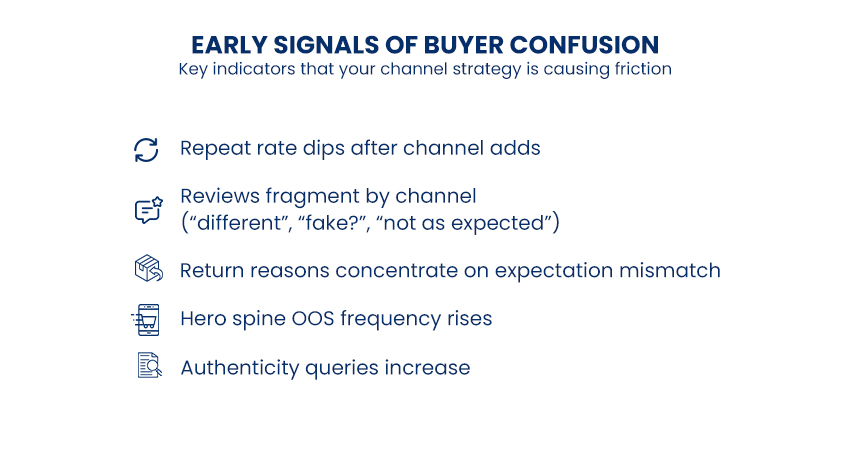
A clean multi-channel scale typically shows up as:
- the hero spine remains dominant and easy to find across doors
- reviews don’t “split into two stories” depending on the channel
- returns don’t rise due to expectation mismatch
- availability becomes dependable in at least one “habit” door
- authenticity queries don’t start appearing as a recurring theme
The end state: recognition without re-decision
The best multi-channel distribution doesn’t feel like the brand is “everywhere.” It feels like the brand is reliably itself wherever the buyer meets it.
The buyer recognises the hero spine instantly. The buyer understands which door to use for which moment. The buyer doesn’t wonder if the product is authentic. The buyer doesn’t have to relearn the range. The buyer doesn’t pause.
That is how a BPC brand grows from one channel to many without confusing the buyer—by treating distribution as identity architecture, not only as reach.
And the timing matters. Online’s share of beauty is projected to keep rising toward ~one-third by 2030, meaning the multi-door experience will become even more normal for the category.
In BPC, the product earns trust once. Distribution either protects that trust—or leaks it one door at a time.