
The moment a claim stops being a copy and starts being a cost
Most founders recall the moment when a claim transitions from marketing copy to a tangible business challenge. This shift rarely occurs in the controlled environment of marketing; it typically emerges in customer support dashboards, often late at night. At this point, support tickets and reviews no longer re ference issues such as “wrong shade,” “late delivery,” or “texture is not for me.” Instead, terms like “misleading,” “not what you promised,” or “overhyped” appear. The instinctive response is to defend the science, citing research, formulation logic, ingredient rationale, and testing. However, these instances reveal that the intended product message has not reached the market as planned.
This is the first communication lesson in Beauty & Personal Care: the formula is always accompanied by the words used to describe it. If the message is even slightly ambiguous, the market will fill in the gaps, often vocally and in public forums. A single clarification post is rarely sufficient to resolve the resulting confusion.
Why BPC communication is getting harder, not easier
Communication has become challenging because the category has become more science-forward at the exact same time that shopping has become faster, feed-led, and headline-driven, which means claims are judged in seconds while their meaning gets rewritten across creators, comments, and quick carts.
When purchasing decisions are made within seconds, claims must be immediately understandable, particularly in beauty, where discovery and purchase are closely linked through digital feeds and rapid transactions. Flipkart’s “Glam Up” beauty trends report, conducted with NielsenIQ, finds that as of 2024, 17% of Indian consumers purchase beauty products online, up from 13% the previous year.
A claim competes not only with other products but also with limited consumer time, attention, and the desire for quick, regret-free decisions. Therefore, communication in Beauty & Personal Care is not merely a soft skill; it determines whether a product is perceived as a genuine solution or as an unsubstantiated promise.
The claim commute: where meaning gets compressed and trust gets decided
It is useful to view a claim not solely as the text printed on packaging, but as the message that endures across all communication channels. The original statement may be altered on the product page, abbreviated in advertisements, condensed into a creator’s summary, further reduced in comment sections, and ultimately reflected in review language that influences subsequent buyers. The critical question becomes whether the claim can be accurately repeated by others without evolving into an unintended promise.
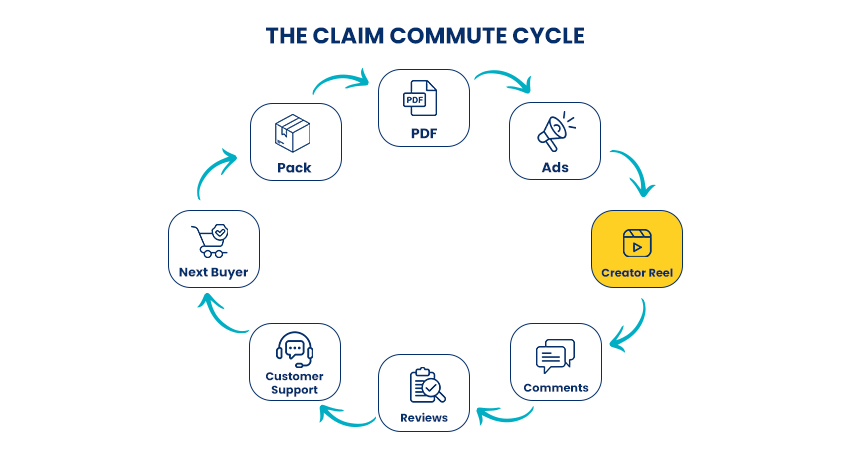
Every stop compresses meaning; trust is the meaning. This example is significant because most brand damage arises not from a single major falsehood, but from incremental, repeated shifts in meaning. While the product remains unchanged, the message evolves at each stage, and customers perceive this gap as a breach of trust rather than a minor discrepancy.
The real translation problem: science is conditional, consumers hear verdicts
In laboratory settings, truth is conditional and such nuance is standard; statements specify conditions, timelines, test contexts, and acknowledge variability. In contrast, consumers interpret claims as definitive verdicts, reflecting the nature of commercial language. This disconnect often traps founders, who adopt scientific terminology to appear credible but fail to translate boundaries into accessible, relatable language.
This tension is amplified by the fact that Indian consumers are simultaneously leaning into “ingredient-forward” behaviour and “clean beauty” comfort cues. An Ipsos report on India’s beauty boom highlights consumer interest in clean beauty and natural ingredients. Buyers are not rejecting science; rather, they seek scientific information that is practical and promises that are mature, with maturity defined by the inclusion of relevant context.
The boundary is not a disclaimer; it is what makes the promise believable
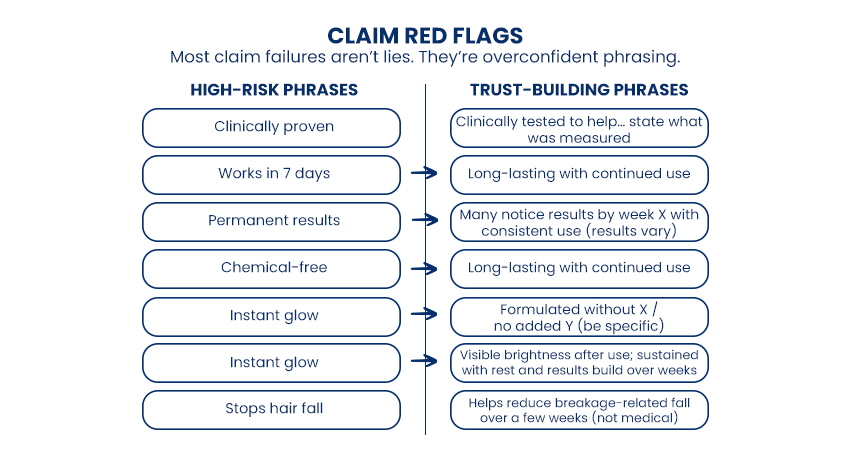
Founders often worry that adding boundaries will weaken their claims. However, in Beauty & Personal Care, boundaries do not diminish a claim; they reduce disappointment, which is a primary cause of lost trust. For example, the phrase “clinically proven” is intended to convey credibility, but consumers may interpret it as a guarantee. This perceived certainty is problematic because it can lead to dissatisfaction when results vary across individuals or depend on usage. A claim such as “reduces pigmentation” is less effective than a more precise statement like “helps fade the look of post-acne marks with consistent use, and outcomes vary by mark depth and daily sunscreen,” which prevents misinterpretation and protects against exaggerated expectations.
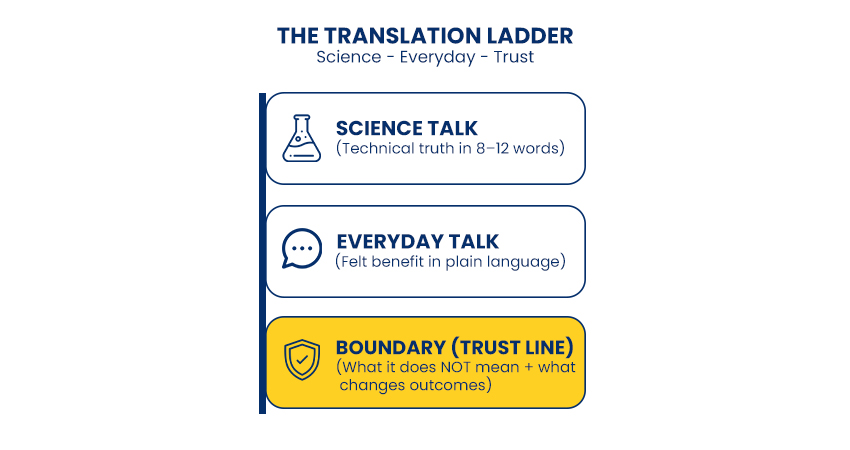
The boundary does not soften the claim; it stabilises. Brands that build long-term trust do so not by making grand promises, but by clearly outlining the steps required to achieve results and empowering customers to participate actively in the process.
Why creator ecosystems make claim design a founder problem
In India, your claims do not only travel through your channels; they travel through other people, and the market often trusts those other people more than it trusts you, which means your brand’s truth can get rewritten by the channel that is driving your reach. Kantar’s widely reported research notes that 67% of Indians trust influencer recommendations over traditional advertisements and that influencer content often outperforms standard digital ads on mid-funnel metrics such as favourability and purchase intent.
At the same time, disclosure discipline is inconsistent, creating an environment where persuasion is high but context is sometimes missing. Advertising Standards Council of India’s “Top Influencer Compliance Scorecard” found that 69% of the top 100 digital stars in its sample failed to meet disclosure requirements, with ASCI also publishing a press note reinforcing the same finding.
For founders, this is significant because creators inherently condense messages due to the constraints of the format. If claims are not designed for this environment, a creator’s summary may become an exaggerated promise, leading to customer disappointment and potential reputational harm.
Proof is a stack, and the stack has to be easy to find
Many emerging brands view “proof” as a singular asset, such as a badge, before-and-after photo, or clinical phrase on packaging. However, customers see evidence of the brand’s commitment in every interaction. Trust erodes rapidly when customers must work to understand claims, as this can create a perception of concealment.
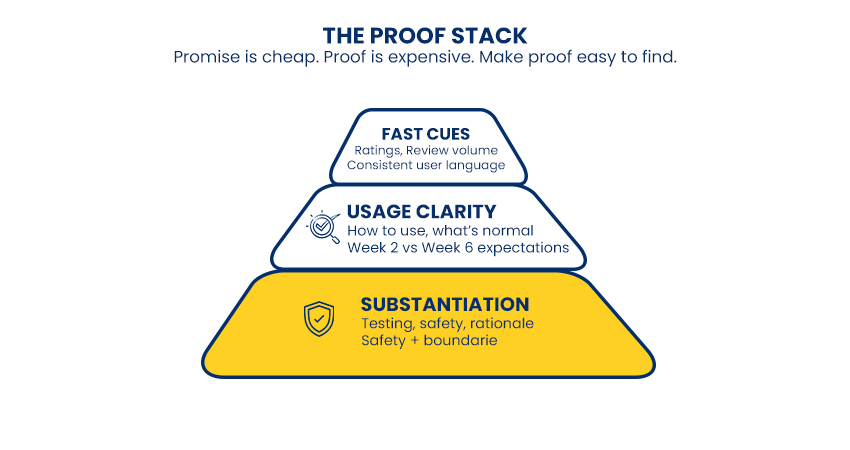
This is where “everyday talk” becomes powerful: it is not only about sounding friendly, but also about building the middle layer, where most disappointment originates. If your product works in eight weeks but you never tell people what to expect in week two, you create a vacuum, and the vacuum gets filled by scepticism, refunds, and harsh reviews.
The education play: brands that win at science-led claims make learning effortless
The best science-led Beauty & Personal Care brands don’t win by sounding scientific; they win by making science easy to use. They win by making science easy to understand without making customers feel lost. The Ordinary, for example, created its O. Library with ingredient glossaries and regimen guides, turning chemistry into simple routines for everyone. They have built mass trust by repeating a legible mechanism narrative around barrier support and ceramides in a way that is easy to remember and retell, which is exactly what a claim needs to survive the commute.
In India, consumer education is particularly critical because a single English phrase may be interpreted differently across regions and languages. Additionally, ingredient “actives” often gain popularity in popular culture more rapidly than accurate knowledge of their use spreads. Terms such as niacinamide, retinol, and sunscreen “PA++++” often become trends before consumers fully understand how to use them safely. Consequently, the most investable beauty brands focus on building both products and clear mental models.
Regulation and enforcement are rising, but the bigger test is still human trust
Regulation matters because it sets the floor, and floors are getting stricter. India’s Guidelines for Prevention of Misleading Advertisements and Endorsements outline penalties clearly, including up to ₹10 lakh for the first contravention and up to ₹50 lakh for subsequent contraventions, along with the possibility of prohibiting endorsers from endorsements for specified periods.
The Supreme Court has also pushed the ecosystem toward greater responsibility, including orders requiring prior self-declaration for advertisements to curb misleading practices, signalling the direction of travel for the broader market.
Globally, the direction is similar: the EU’s common criteria for cosmetic claims emphasise principles such as honesty and evidential support, reinforcing that “claims” are not just creative, they are expected to be justified and not exaggerated beyond the evidence.
But founders shouldn’t see this as just a legal issue. Most brands lose trust long before a regulator steps in, and consumers are often tougher than any guideline, because their judgment is emotional and public.
One thing that sets mature Beauty & Personal Care brands apart from chaotic ones is having a single source of truth for each main claim. The most common reason young brands end up with misleading claims isn’t bad intent, it’s improvisation. The pack says one thing, the product page says another, the creator brief says something else, and customer support writes a fourth version under pressure.
This is where the founder’s voice matters. When a brand openly admits that results can vary, customers usually appreciate it. It shows respect.
The economics of trust: why communication shows up as CAC, returns, and review language
When people say “trust,” founders sometimes hear “brand,” and investors sometimes hear “soft moat,” but consumers treat trust as a purchase criterion, and large-scale research reflects this. Edelman’s 2025 brand trust special report shows that trust is a major purchase consideration, alongside cost and quality, with “I trust it” rated as critical or important by a large share of respondents.
In India’s current D2C environment, the cost of getting claims wrong is increasingly visible, as industry bodies and the media have highlighted how frequently misleading claims lead to violations. An Economic Times report citing ASCI findings notes that a large share of ad violations in FY24 were due to misleading claims.
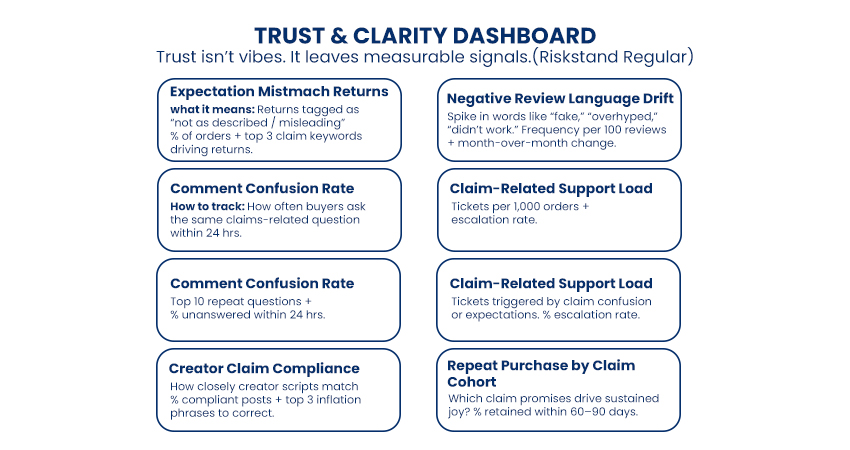
This is why communication is not merely persuasion; it is expectation management, and expectation management is unit economics protection, because the cheapest conversion is the one you do not have to re-buy after disappointment.
When founders track these metrics, communication stops being subjective feedback and becomes a performance lever you can actually improve.
How to write BPC claims that feel warm, human, and still defensible
Warmth in BPC is not emojis and exaggerated adjectives; warmth is when a consumer feels the brand is trying to help them get it right, not trying to win a word game. The writing trick that consistently works is to move away from miracle outcomes and toward guided paths, because paths are both more honest and more effective in the long run and give consumers agency.
A warm, trustworthy claim, therefore, tends to include an everyday outcome and a realistic timeline in the same breath, and when necessary, it includes a boundary that sounds like care rather than fine print, because fine print that contradicts the main headline does not rebuild trust; it increases suspicion. This is also why creator language must be designed, not left to chance, because creators will compress, and the format rewards certainty; Kantar’s India research has shown influencer content can hold attention significantly longer than traditional branded content, which makes creator-led messaging an even more powerful meaning-shaper in the claim commute.
This is where the founder’s voice matters, because when a brand admits variability like an adult, customers do not punish it; they often reward it, because it signals respect.
The point of truth: what “complete communication” in BPC actually covers
When you say you want this blog to be a point of truth, what you are really asking for is a map that founders and investors can both trust, and the map is simple even if execution takes discipline: communication in BPC must cover pack language that is legible, PDP language that translates and guides, ads that compress without inflating, creator briefs that prevent mutation, customer support scripts that answer with clarity rather than defensiveness, and review ecosystems that are responded to in ways that reinforce the brand’s truth rather than argue with the consumer’s lived experience.
If you do not design each layer, the market designs it for you, and the market does not have your nuance, your lab notes, or your long-term brand interest, because the market only has the sentence it heard.
The founder’s rule that scales
The biggest communication upgrade in BPC is not learning to sound more scientific, and it is not learning to sound more poetic; it is learning to finish the sentence, because finished sentences are what survive the claim commute without turning into something you never intended. When you translate science into everyday talk, and you include boundaries that feel like care, you reduce disappointment, you protect trust, and you earn the right to scale, because the brand’s most expensive problems in beauty are rarely supply chain problems; they are trust problems that show up as returns, reviews, and rising acquisition costs.