For decades, business in India has been conducted within an established structure in which language, especially English, has played a defining part in how products are displayed, understood, and ultimately bought by customers. Whether in retail stores, on product labels, on catalogues, or on e-commerce websites, there has been an underlying assumption that consumers would adapt to the brand’s language. This assumption is now being challenged in a far more structural and irreversible way.
What we are witnessing here is not just a shift in how people interact with each other, but also a huge transformation in how commerce is accessed, interpreted, and trusted in the online and offline worlds. As India’s consumer base expands into deeper Tier 2, Tier 3, and rural emerging markets, language is no longer just a secondary layer of the buying process. It is increasingly becoming the primary interface through which commerce is experienced, evaluated, and completed.
India now has over 950 million internet users, and according to the Internet and Mobile Association of India and Kantar, nearly 98% of users consume content in Indic languages such as Tamil, Telugu, and Malayalam. This is not just a distribution shift, but a behavioural one. Close to 68% of consumers prefer engaging with information in their native language, and nearly 88% trust local language content more than English, indicating that language is increasingly shaping both attention and decision-making.
This is not just a content preference, but a shift in how decisions are formed, especially in markets where trust needs to be built through familiarity and clarity.

At its core, commerce runs on trust, and trust is built through clarity that reduces hesitation and enables decision-making. When consumers engage in a language they are comfortable with, they are able to understand products more easily, which in turn accelerates their willingness to move forward with a purchase.
This is visible even in something as simple as packaging, where companies like Hindustan Unilever and ITC Limited have increasingly incorporated descriptors in vernacular languages like Tamil, Telugu, and many more, across brands such as Aashirvaad and Sunfeast, while Amul has also built a large consumer base through regional-first communication across products and advertising.
Britannia offers a more contemporary example. Its BourbonIT Challenge 2.0 was launched in seven Indian languages, including Tamil, Telugu, Bengali, Marathi, Gujarati, and Kannada, showing how even a mainstream FMCG brand now sees multilingual experience design as a way to deepen participation and accessibility rather than simply widen reach. The campaign invited consumers to scan the pack and generate recipes guided by an AI avatar of Chef Pooja Dhingra in their preferred language, turning language into an interactive, personalised layer of the product experience rather than just a communication choice.
What is happening in FMCG is mirrored even more strongly in entertainment and sport. JioHotstar describes itself as a platform with over 100,000 hours of content in 17 languages, while its interface already supports multiple Indian languages beyond English. Across the OTT market, 48% of content released in 2024 was in regional languages, and by 2025, regional languages had grown to 56% of OTT share.
Even cricket, perhaps the country’s most mainstream media property, is now designed this way, with IPL 2026 offered through 12 language options, over 20 feeds, and more than 150 experts. Together, these shifts show that multilingual behaviour in India is no longer limited to Hindi versus English. It now spans Tamil, Telugu, Bengali, Marathi, Gujarati, Kannada, Malayalam, and more, with platforms and brands increasingly restructuring themselves around that reality.
What may be perceived as a packaging decision is, in fact, a shortcut for the decision-making process that helps reduce cognitive efforts for the consumer and makes the process more intuitive. In categories where consumer awareness and education are important factors, like food, healthcare, or beauty, this factor becomes even more relevant as it can have a direct impact on understanding and trust.
The Next Consumer Will Not Adapt. The System Will
India’s next wave of consumption is not being driven by consumers adapting to existing systems, but by systems gradually reshaping themselves to align with how consumers already behave and interact. Rural India already accounts for nearly 57% of internet users, and a large share of incremental consumption is expected to come from these markets.
As this growth expands beyond metros, much of it is coming from Tier 2 and Tier 3 cities, where consumers are not new to commerce itself, but are relatively new to organised and digital formats. Their entry into commerce is often guided by conversation, recommendation, and assisted interactions rather than being purely driven by search or independent discovery.
Platforms such as Meesho have scaled precisely by aligning with this behaviour, enabling sellers and buyers from non-metro India to transact through conversational and assisted commerce flows, which has resulted in over 80% of its users coming from Tier 2 and smaller cities.
Similarly, PhonePe has also launched multilingual and voice-based interfaces, allowing users to conduct financial transactions in 10+ Indian languages. This is also evident in user behaviour: nearly 40% of users on the PhonePe Indus Appstore use regional languages to navigate the app, indicating the role of language in the app’s growth in Tier 2 and Tier 3 markets.
For a large segment of India, commerce does not begin on a product page, but starts earlier within conversations and recommendations that shape intent before discovery even happens.
Discovery Has Moved Closer to Culture
In modern commerce, the discovery process starts much earlier than the actual point of purchase, and this discovery is being further dictated and driven by vernacular content and context. Around 75-80% of Indian consumers rely on social media to discover products, and a large chunk of this consumption is in regional languages.
In this context, it is safe to say that the discovery process is no longer dictated and driven by brand messages but by relatability, familiarity, and context. The context and contextuality of a product, displayed in a familiar language and environment, have a much greater influence than brand messages.
One clear signal of this shift is the way Google and YouTube are shaping discovery trends in India. More and more search activities are now being conducted in vernacular languages, and voice search is further fueling this trend, where users are more likely to converse in their natural language. Google reports that voice searches in India have grown by over 250–270% in recent years, largely driven by non-English users, with Hindi emerging as one of the most widely used languages on Google Assistant globally.
Meanwhile, YouTube’s consumption in India is largely fueled by Indic language content, as 95% of online video content viewers prefer non-English content. Not only is content consumption occurring, but it is also being actively leveraged as a means of learning, evaluating, and deciding before making an actual purchase.
These developments make discovery more conversational, contextual, and culturally relevant, replacing keyword-based search and brand-based messaging with something much more intuitive and trust-based.
For founders, this fundamentally changes how demand needs to be built, as reach without contextual relevance is increasingly ineffective in driving meaningful engagement or conversion.
Retail Is Being Quietly Re-Engineered Around Language
This shift is not limited to digital platforms, but is increasingly visible across physical retail environments as well, where language is shaping how consumers navigate and engage with products. Modern trade stores are incorporating regional signage, multilingual assistance, and localised merchandising, while e-commerce platforms are enabling browsing and transactions in multiple Indian languages.
This is reflected in adoption patterns at scale, where rural and semi-urban India account for a significant share of the retail growth expected in the coming years. Consequently, kirana stores still account for nearly 85–90% of India’s retail market and have long operated on conversational commerce rooted in local language.
A strong example of this transition into organised retail can be seen in Big Bazaar, which scaled to over 290 stores across 120+ cities before its decline, using regional language-first signage and familiar, market-style communication to make modern retail feel accessible and relatable for first-time consumers.
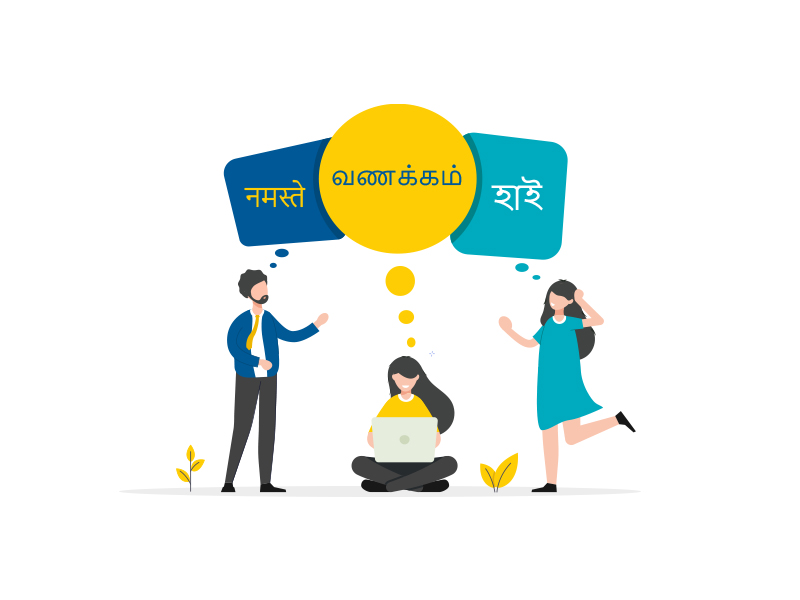
What is important to note, however, is that vernacular in India is not limited to Hindi. It spans a wide linguistic spectrum, including Tamil, Telugu, Bengali, Marathi, Kannada, Malayalam, Gujarati, and more, each shaping commerce differently across regions. This becomes even more evident when we move beyond retail into communication-led platforms that influence buying behaviour.
Platforms like WhatsApp have effectively become infrastructure for conversational commerce in India, with over 535 million users as of early 2026, making it the platform’s largest market globally. More importantly, over 200 million users in India interact with business accounts, and nearly 80% of small businesses consider it critical to their day-to-day operations. What was once a social messaging tool has now evolved into a business lifeline, enabling millions of SMEs and D2C brands to connect, engage, and transact with consumers.
Whether it is a kirana store owner sharing product updates in Gujarati, a home-based seller negotiating prices in Tamil, or a service provider onboarding customers in Bengali, the transaction layer itself is increasingly language-native. This is further amplified by the adoption of WhatsApp Business tools such as catalogues, payments, and automation, which allow commerce to happen entirely within conversations rather than through formal storefronts.
In parallel, platforms like Google Pay and Paytm have scaled by building financial transactions around language-native interfaces rather than English-first systems. Google Pay supports over 10 Indian languages, including Tamil, Telugu, Kannada, and Malayalam, enabling users across non-metro markets to navigate payments in their preferred language. Similarly, Paytm has expanded its interface across multiple regional languages, with a significant share of its adoption coming from Tier 2 and Tier 3 users. This becomes critical in a category like payments, where trust and clarity directly impact behaviour, reinforcing that vernacular language spans a broader linguistic ecosystem shaping everyday financial interactions.
What is changing now is that organised commerce is not just adopting these behaviours, but systemising them across formats, making modern commerce feel more intuitive and closer to how India has always transacted.
Behaviour Is Changing, and Behaviour Compounds
When consumers interact in their own language, their behaviour changes in ways that directly impact business outcomes and brand relationships. Consumers ask more questions, spend more time learning about products, and build more conviction before making a purchase decision.
Studies have shown that regional language campaigns can achieve 25-30% higher engagement compared to English-only campaigns. Moreover, platforms like Meta have also observed that conversion rates for local language campaigns are higher compared to English-only campaigns, especially in non-metro geographies.
What is interesting is that the decision-making process for consumers has changed significantly from shallow comparisons to informed decision-making. While English-first journeys result in quicker decisions with less conviction for purchase, vernacular journeys result in higher conviction for purchase.
This results in a different type of growth curve, where conversion may take longer initially but leads to stronger retention and advocacy over time.
Early Movers Are Building Disproportionate Advantage
Several segments have already begun to emerge in line with this trend and highlight the potential for language to be a driver for scale and depth of engagement. Dabur has always used the language to create familiarity for its brand, while others like Rapido, Zomato, and Swiggy have used local language creatives to grow beyond their current metros-only user base.
A more nuanced example can be seen in the way in which JioMart has gone about growing its presence by using local kirana stores and making the transactional experience more language-driven and conversational in nature, rather than making the experience seem alien to users.

Similarly, Paytm has grown its presence in smaller towns by localising its interface to support multiple Indian languages.
What Founders Should Do Differently
For founders, this means more than just adding language options. It means making vernacular thinking a part of how the brand works and interacts with customers. It starts with understanding how people act as consumers by watching how they talk, learn, ask questions, and make decisions in their own situations.
It also needs to change how people discover things, which usually starts with content, conversations, or recommendations that are relevant to the person and their language. Points of conversion, like packaging, product descriptions, onboarding flows, and customer support, need to make things easier and less confusing.
There is also an emerging requirement to build for assisted and conversational commerce, where sellers, influencers, and communities can explain products in local languages, especially in non-metro markets. Along with this, there is the requirement for the founders to infuse voice-led features in their products and services, allowing users to search, interact, and transact in the language of their choice, as voice is becoming the natural interface for first-time and non-English users.
Instead of translating existing systems, founders must think in terms of designing an experience that feels completely native from the start. This requires designing an experience that aligns language, tone, and context with how consumers think. A good place to start is by understanding where language creates friction in the customer journey and solving that layer deeply before going further.
This eventually leads to stronger trust and brand relationship levels, which are much easier to defend than acquisition-related gains.
To conclude, vernacular is often positioned as a way to unlock new markets, but in reality, it is reshaping the very definition of the market itself. Commerce in India has always been conversational, contextual, and rooted in local behaviour, and what is changing now is that organised commerce is beginning to reflect these characteristics at scale.
This shift is not about adding a feature or optimising a channel, but about rethinking how commerce systems are designed to align with consumer behaviour. The question for founders is no longer whether vernacular matters, but how deeply it will shape the categories they are building in.
Because the brands that will succeed are not just those that reach consumers, but those that are understood by them in a way that builds trust and long-term relevance. And in India, being understood increasingly begins with language.